


Buy Premium Fish Tank Filters: 2026 Review Guide
Buy premium fish tank filters with confidence. We review top models by tank size, flow rate, and media cost to help you choose the right one.

Last Updated: October 23, 2026
Quick Summary
Buy premium fish tank filters by matching the filter to your tank's actual water volume, then stepping up one size for heavily stocked tanks. Check loaded flow at the outlet, price replacement media over three years, and confirm parts are sold separately. Premium models win because standard media and serviceable motors cut long-term costs.
- A 40-gallon tank wants roughly 160-240 gallons per hour of actual output.
- Rinse biological media in tank water, never tap water, to protect the bacteria colony.
- A $6 cartridge swapped monthly costs $216 over three years, more than many filters cost new.
- Canister filters are best for tanks over 40 gallons and planted setups.
- Check loaded flow, price media for three years, confirm parts, and read the warranty.
Table of Contents
- Why Buy Premium Fish Tank Filters Instead of Bargain Models
- Best Aquarium Filters for Every Tank Size
- Canister Filter vs Hang-On-Back Filter: Which Fits Your Setup?
- Aquarium Filter Flow Rate: Finding the Right Gallons Per Hour
- Aquarium Filter Replacement Media: Costs and Schedules
- Total Cost of Ownership: What You'll Spend Over Three Years
- How We Evaluated These Filters
- Conclusion: Matching a Filter to Your Fish and Your Budget
- Frequently Asked Questions
Why Buy Premium Fish Tank Filters Instead of Bargain Models
A fish tank filter is the piece of equipment that decides whether your tank stays clear or turns cloudy within a week.
The math is not complicated. A bargain filter that costs less up front often costs more by month eighteen, because replacement parts are scarce and the motor wears out faster.
Below, we break down sizing, filter types, flow rates, media costs, and three-year ownership so you can buy premium fish tank filters with confidence.
Best Aquarium Filters for Every Tank Size
Sizing is the first decision, and most guides get it wrong by trusting the box rating alone. A filter rated "up to 30 gallons" rarely performs well on a fully stocked 30-gallon tank. Match the filter to your tank's actual water volume, then step up one size if your tank is heavily stocked.
Pro Tip
Check the filter's rated flow at the height it will actually run. A pump rated at 200 gallons per hour at zero lift may deliver far less once it pushes water up a return tube.
Nano Tanks (Up to 3 Gallons)
Small tanks need gentle flow and a compact footprint. The Aquatop Forza Sphere PFE-Mini hang-on filter measures just 2.1 x 1.8 x 3.5 inches and fits rimless nano tanks up to 3 gallons. It runs a 3-stage filtration system and includes a foam intake guard that protects shrimp, eggs, and fry from being drawn in. For a desktop shrimp tank, this is the pick we would make.
Mid-Size Tanks (10-50 Gallons)
For a 10-50 gallon setup, the adjustable fish tank filter for 10-50 gallon tanks gives you a dial to tune flow between gentle and strong. Its 8-watt pump pushes up to 200 gallons per hour, and the package includes two nozzles plus multiple media options. It suits freshwater or saltwater and carries a 180-day repair guarantee from the manufacturer.

Large Tanks (30-60 Gallons)
Larger tanks need turnover and media capacity. The Power Aquarium Filter with 3-step filtration handles 30-60 gallons and filters up to 330 gallons per hour. It uses a biological grid that never needs replacing, plus activated carbon to pull odors and discoloration. Expect to swap the cartridge monthly, since carbon loses potency as it works.

Canister Filter vs Hang-On-Back Filter: Which Fits Your Setup?
Canister filters win on media volume and quiet operation; hang-on-back filters win on price, simplicity, and easy cleaning.
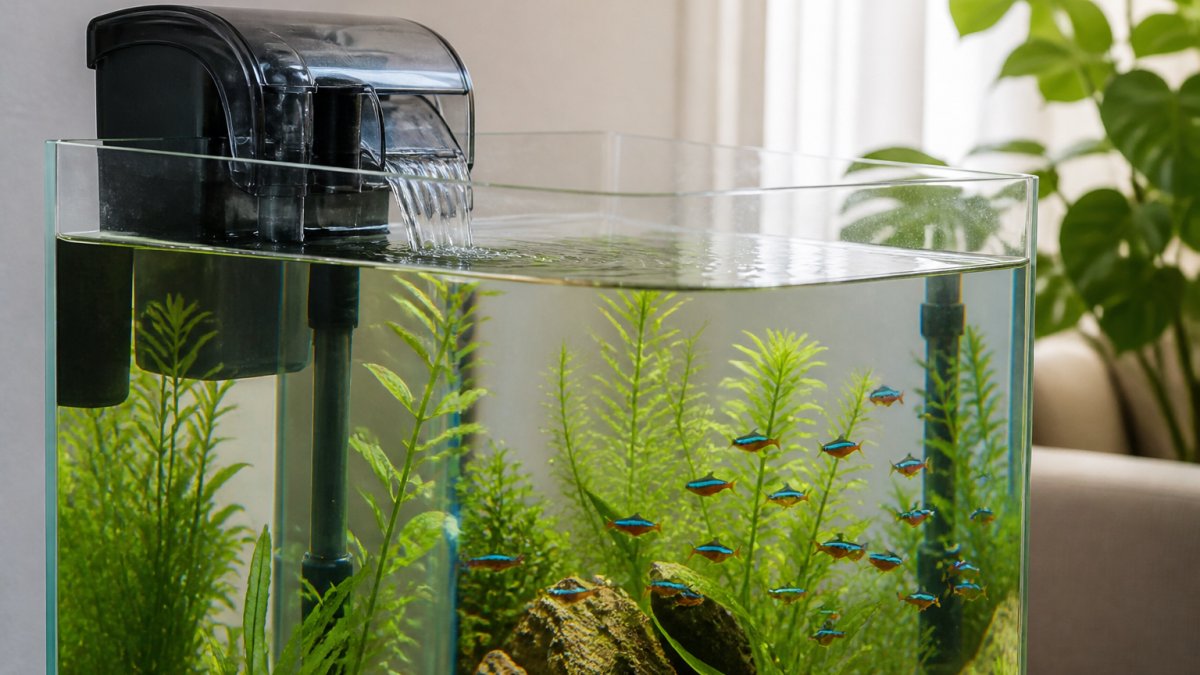
If you want a hang-on-back with a visible return, the Aquarium Filter Waterfall Flow offers a waterfall output and double-layer biochemical filtration with activated carbon. It runs at 5 watts and suits tanks up to 20 gallons or larger, including turtle and amphibian setups.
| Filter Type | Media Capacity | Maintenance | Best For |
|---|---|---|---|
| Canister | High | Every 4-6 weeks | Tanks over 40 gallons, planted setups |
| Hang-on-back | Medium | Every 2-4 weeks | Most community tanks, beginners |
| Internal | Low | Weekly rinse | Nano tanks, quarantine tanks |
| Sump | Very high | Monthly | Reef and large systems |
Aquarium Filter Flow Rate: Finding the Right Gallons Per Hour
The right flow rate turns your tank volume over four to six times per hour for most freshwater setups. A 40-gallon tank wants roughly 160-240 gallons per hour of actual output. Reef tanks often need more, while betta and shrimp tanks need less.
Manufacturer ratings are measured at the pump, not at the outlet. Account for filter media, lift height, and plumbing restrictions, which all reduce real flow. If your filter is rated at 200 gallons per hour, plan for less at the tank.
Watch Out
Oversizing flow in a betta or shrimp tank creates a stressful current. Baffle the output or choose an adjustable model rather than running a large pump wide open.
Aquarium Filter Replacement Media: Costs and Schedules
Media costs are where budget filters quietly fail. Proprietary cartridges that only fit one model can disappear from shelves. Stick to filters that use standard foam, floss, and carbon, or buy a model that ships with spare cartridges so you can compare replacement needs up front. The aquarium power filter with 3 cartridges includes three disposable cartridges and a five-stage design with biomedia, mechanical floss, activated carbon, and phosphate remover spheres.

| Media | Replace | Cost Pattern |
|---|---|---|
| Mechanical floss/pad | Every 2-4 weeks | Low, frequent |
| Activated carbon | Monthly | Low, frequent |
| Biological media | Rinse only, rarely replace | One-time |
| Phosphate remover | Monthly | Moderate |
Rinse biological media in tank water, never tap water, to protect the bacteria colony.
Total Cost of Ownership: What You'll Spend Over Three Years
Purchase price is the smallest part of what a filter costs you. The number that matters is purchase price plus replacement media plus electricity plus the odds you replace the unit before year three. Most buying guides stop at the sticker, which is why so many shoppers end up paying twice.
Here is the framework we use, with the variables you can check yourself before checkout.
The four cost lines
- Purchase price. The one-time outlay. Premium canister and power filters typically sit in the $60-$200 band; bargain hang-on-backs sit under $30. That gap is real, but it is not the whole story.
- Replacement media. Add up every cartridge, pad, carbon pouch, and phosphate pad the manufacturer says to swap, multiply by swaps per year, then by three. Proprietary cartridges are the silent budget killer: a $6 cartridge swapped monthly is $216 over three years, more than many filters cost new.
- Electricity. Watts ÷ 1,000 × hours run × your utility rate. A 5-watt hang-on-back running 24/7 uses about 44 kWh per year; at a typical residential rate that is a few dollars annually. A 20-watt canister uses roughly 175 kWh per year. The difference is small next to media, but it belongs in the math.
- Failure and replacement risk. Bargain motors with sealed, non-serviceable impellers often lose flow within 12-18 months. If you replace a $25 filter twice in three years, you have spent $75 and thrown away two bacteria colonies, a livestock stress event, not just a line item.
A worked three-year example
Take a 40-gallon community tank. A premium power filter at $78.99 with a permanent biological grid needs only mechanical pads and carbon: budget roughly $40-$60 per year in media, so about $120-$180 over three years, plus a few dollars of electricity.
Power Aquarium Filter 3-Step Filtration, 30-60 Gallons →
A $25 bargain unit with $6 monthly cartridges costs $216 in media alone over three years, plus likely one full replacement at $25, plus the electricity. Total ownership lands near $270-$300, and you still have a weaker motor at the end.
Key Takeaway
The premium filter does not win because it is fancy. It wins because the media is standard, the biological grid does not need replacing, and the motor survives the three-year window. Run the media math before you run the price comparison.
What to check before you buy
- Media standardization. Does the filter take generic foam, floss, and carbon, or a single proprietary cartridge? Generic media is cheaper per swap and available for years.
- Biological media lifespan. Sintered glass or ceramic biomedia is rinse-only and effectively permanent. Disposable "bio-cartridges" are a recurring cost disguised as filtration.
- Impeller and motor serviceability. Can you buy a replacement impeller, or is the motor sealed? A $10 impeller extends a filter's life by years.
Add these five checks to the purchase price and you have the real cost of ownership, the number competitors leave out.
How We Evaluated These Filters
Most filter roundups tell you what they recommend but not how they decided. We think the method matters as much as the pick, so here is exactly what we measured, what we compared, and where the judgment calls sit.
The five criteria and how each was assessed
1. Real flow at the outlet. Manufacturer gallons-per-hour ratings are measured at the pump with no media and no lift.
**2.
3. Build quality and motor noise. We look at housing thickness, seal design, impeller access, and whether the motor is serviceable.
4. Suitability across freshwater and marine setups. A filter that only works in freshwater is not a universal pick.
**5.
Sizing honesty
A filter rated for 30-60 gallons should hold flow on a stocked tank in that range, not an empty one. We penalize models whose ratings assume a bare tank, and we reward adjustable flow because it lets one filter serve a range of bioloads without stressing fish.
What we did not test
We did not run lab-grade flow meters or long-term reliability trials. Our flow and noise assessments are comparative and practical, not instrumented. Where a claim depends on the manufacturer's spec, we say so. Where we are giving a judgment call, build feel, ease of cleaning, media flexibility, we frame it as a judgment call.
Pro Tip
Use this method yourself: check loaded flow, price the media for three years, confirm parts are sold separately, and read what the warranty actually covers. That four-step check will separate a premium filter from a premium price tag.
Conclusion: Matching a Filter to Your Fish and Your Budget
The right filter depends on your tank, your livestock, and how much maintenance you want to do. Nano keepers should start small with a shrimp-safe unit, mid-size tanks benefit from adjustable flow, and larger tanks need turnover and media capacity. Buy premium fish tank filters once, service them properly, and your water stays clear.
Frequently Asked Questions
What is the best premium filter for a fish tank?
The best premium fish tank filter depends on tank size and livestock. For a 30-60 gallon tank, the Power Aquarium Filter 3-Step Filtration at $78.99 offers 330 GPH and a biological grid that never needs replacing. For tanks up to 3 gallons, the Aquatop Forza PFE-Mini at $11.99 provides three-stage filtration with a shrimp-safe intake guard. Match the filter's rated capacity to your tank and check that replacement media is easy to find and affordable.
Are canister filters better than hang-on-back filters?
Neither is universally better. Canister filters hold more media and suit larger tanks, but they cost more and take longer to clean. Hang-on-back filters, like the Power Aquarium Filter 3-Step Filtration at $78.99, are easier to maintain and work well on tanks up to 60 gallons. Choose a canister filter if you have a heavily stocked tank; choose a hang-on-back for simpler setups and lower upfront cost.
How do I choose a filter for my aquarium size?
Use the manufacturer's tank rating as a starting point, then aim for a flow rate that turns over your tank volume 4-6 times per hour. For a 20-gallon tank, that means 80-120 GPH. The Adjustable Fish Tank Filter for 10-50 Gallon Tanks delivers up to 200 GPH and lets you dial it back, making it flexible for community tanks. Always size up if your fish produce a heavy bioload, such as goldfish or turtles.
How often should I replace aquarium filter media?
Replace activated carbon and mechanical floss every month, because carbon deactivates as it absorbs impurities. The Power Aquarium Filter 3-Step Filtration requires a monthly cartridge change for this reason. Biological media, such as the bio-tech grid on that same filter, never needs replacing. Rinse sponge and foam media in tank water every two to four weeks to preserve beneficial bacteria, and never rinse them under tap water.
Where can I buy reliable aquarium filters online?
Buy from a retailer that lists exact flow rates, tank ratings, and replacement media costs upfront. Walnut Creek Supply carries five filters ranging from $11.99 to $78.99, including the Aquarium Filter Waterfall Flow at $26.60 for turtle and amphibian tanks. Check the return policy and confirm that replacement cartridges are in stock before ordering, so you are not stuck with a filter you cannot maintain.
Choosing a filter can feel like guesswork, but it does not have to be. At Walnut Creek Supply, we stock filters sized for nano, mid-size, and large tanks, with replacement media you can reorder when you need it. Browse our fish filters and pumps to match a filter to your tank, or start with our nano, adjustable, and power filter options and compare flow rates side by side. Continue shopping with Walnut Creek Supply and give your fish the clean, stable water they deserve.


