


7 Steps to Transition Pet Food Safely Without Stomach Upset
Learn how to transition pet food safely with a 7-day schedule that prevents stomach upset. Mix old and new food gradually and know the warning signs.

Last Updated: October 29, 2026
Quick Summary
To transition pet food safely, blend the old food with the new food over seven to ten days, starting at 25% new food and increasing gradually until the bowl is all new food by day seven. Hold at any ratio longer if stool gets soft, and stretch the schedule to 10 to 14 days for puppies and kittens.
- Start at 25% new food and 75% old food for the first two days.
- Move to a 50/50 mixture on days three and four, watching stool firmness.
- Hold the current ratio two to three extra days if mild upset appears.
- Stretch the schedule to 10 to 14 days for puppies and kittens.
- Return to the last ratio that produced firm stool if diarrhea lasts over 24 hours.
Table of Contents
- Why a Gradual Food Transition Matters for Digestion
- Your Pet Food Transition Schedule: A 7-Day Plan
- How to Mix Dog Food for Transition (and Cats Too)
- Signs of Digestive Upset in Pets During a Food Change
- Adjusting the Pace for Puppies, Seniors, and Sensitive Stomachs
- When to Slow Down, Pause, or Call Your Veterinarian
- Stock Your Transition Kit at Walnut Creek Supply
- Frequently Asked Questions
Why a Gradual Food Transition Matters for Digestion
Your pet's digestive system runs on a steady community of bacteria and enzymes tuned to the current diet.
A fast switch often ends up cleaning carpets. A slower transition pet food plan avoids most of that.
The payoff is worth the patience:
- Fewer stomach upsets and messy accidents
- A pet that actually accepts the new flavor
- A clear view of whether the new diet agrees with them
The American Veterinary Medical Association's guidance on pet nutrition backs the slow approach. So does every vet we've ever talked to.
Your Pet Food Transition Schedule: A 7-Day Plan
A seven-day pet food transition schedule works for most healthy dogs and cats. You add a little more new food each day while the old food shrinks.
A seven-day plan like this is easy to follow: measure both foods, mix them, and serve.
| Days | Old Food | New Food | What to Watch |
|---|---|---|---|
| 1-2 | 75% | 25% | Loose stool, gas, appetite |
| 3-4 | 50% | 50% | Stool firmness, energy |
| 5-7 | 25% down to 0% | 75% up to 100% | Full acceptance, no vomiting |
Days 1-2: The 25/75 Starting Ratio
Start with 25% new food and 75% old food. Most pets won't even notice the change at this ratio.
Mix it thoroughly so your pet can't pick out the old pieces. A hungry dog will try.
Days 3-4: Moving to a 50/50 Mixture
Bump it to a 50/50 mixture. This is where sensitive pets sometimes show their first signs of trouble.
If stool gets soft, hold at this ratio for an extra day or two. There's no prize for finishing fast.
Days 5-7: Reaching 100% New Food
Increase the new food each day until the bowl is all new food by day seven. Watch the last two days closely, since this is when refusal or upset tends to show up.
How to Mix Dog Food for Transition (and Cats Too)
Mixing is the same for dogs and cats: measure both foods by volume, combine them in one bowl, and stir until evenly blended. The difference is the pace, not the method.
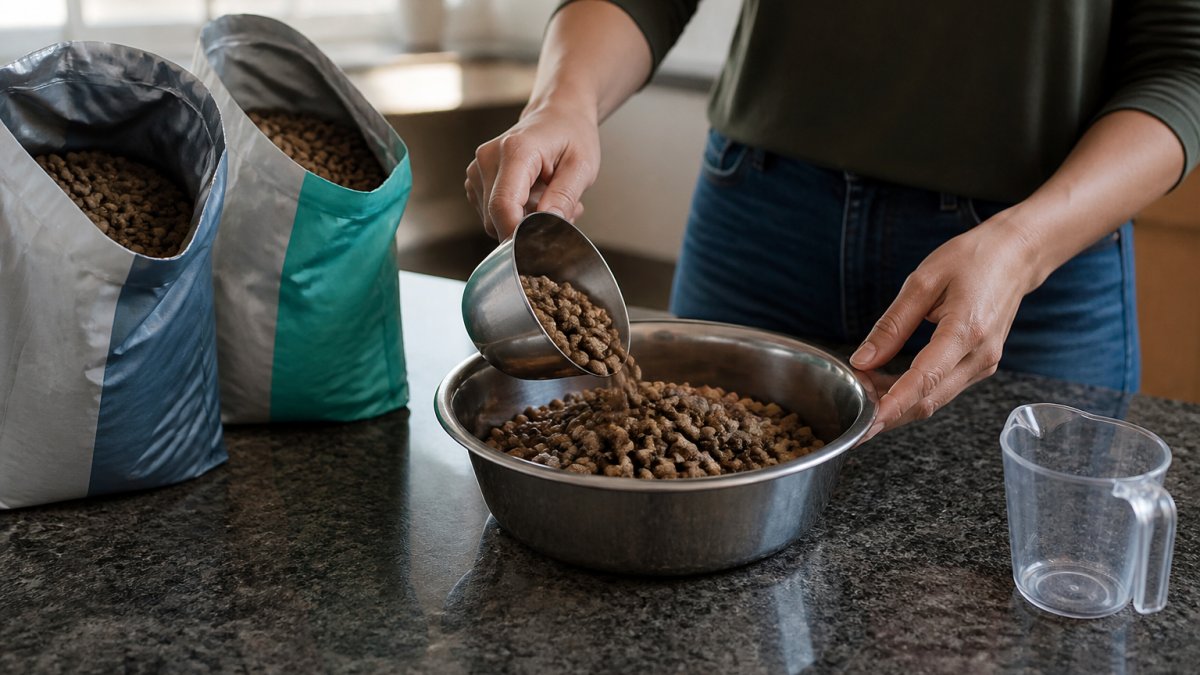
Here's a simple way to do it at home:
- Scoop the old food into the bowl first, using your normal measuring cup.
- Add the new food on top in the correct proportion.
- Stir for a few seconds until the pieces are evenly spread.
- Serve right away so nothing gets picked apart. A silicone slow feeder helps pets who gulp their mixed meals too fast.
Cats are the fussier of the two. They imprint on texture and smell early, so a fast switch often triggers a full food strike.
Signs of Digestive Upset in Pets During a Food Change
Most food-change reactions are mild and short-lived. The useful skill is telling a normal adjustment apart from a problem that needs a different response. Here is how to read the signs and what to actually do at each level.
Level 1: Expected adjustment (keep going, hold the ratio)
- One soft stool, or stool that is slightly softer than usual for a day
- Mild gas or a rumbling stomach after meals
- A pet that sniffs the new food but still eats most of it
What to do: Hold at the current old/new ratio for two to three extra days before increasing the new food. Do not push forward on the calendar just because the schedule says so. Most mild upset resolves once the gut bacteria and enzymes catch up to the new formula. A digestive support chew can help settle a pet's stomach while it adjusts.

Level 2: Slow down and step back (pause, then retreat one step)
- Diarrhea lasting more than 24 hours but the pet is still drinking and acting normally
- Vomiting once or twice, then stopping
- Refusing the mixed meal but eating the old food when offered alone
What to do: Return to the last ratio that produced firm stool and hold it for three to four days. Then increase the new food in smaller increments, roughly 10% at a time instead of 25%. If the same reaction returns at the same percentage, that is a signal the new food itself may not agree with your pet, not just the pace.
Level 3: Stop and call your veterinarian
- Repeated vomiting, or vomiting with lethargy
- Diarrhea lasting more than 48 hours, or any diarrhea in a puppy or kitten
- Refusing all food for more than 24 hours
These go beyond a normal transition. A pet that will not eat for a day is at risk of a worse problem than the food change itself, especially cats, which can develop serious liver complications after only a few days of not eating.
Gut Garden Digestive Support Chews →
Itching, paw licking, and ear issues are a different track
Skin signs are not digestive upset, and they usually do not show up in the first week. If scratching, paw licking, or ear redness appears weeks into a new food, that points toward a possible adverse food reaction rather than a transition problem. Do not keep cycling through foods on your own; ask your vet about an elimination diet rather than guessing.
Watch Out
Do not use over-the-counter anti-diarrheal medications on a pet without veterinary guidance. Some human products are unsafe for dogs and cats, and masking diarrhea can hide a worsening problem.
Adjusting the Pace for Puppies, Seniors, and Sensitive Stomachs
A seven-day plan is a default for healthy adult pets, not a rule. Life stage, health status, and the type of switch all change the right pace. Use the guidance below to pick a starting point, then let your pet's stool and appetite set the real timeline.
Puppies and kittens
Young animals have smaller digestive systems and less reserve. Stretch the schedule to 10 to 14 days, and make smaller jumps between ratios. Puppies and kittens also have different nutritional requirements than adults, so the new food should be formulated for growth. If a puppy or kitten develops diarrhea, do not wait it out the way you might with an adult; young animals dehydrate faster and should be seen by a vet sooner.
Seniors
Older pets often have slower digestion, reduced appetite, and underlying conditions that are not obvious. Plan on two weeks or longer, and watch body weight during the switch. Senior pets that lose weight or stop eating are a veterinary concern, not just a scheduling problem. Senior dog owners following the slower senior transition plan may want a senior-specific dry food as their new diet.
Sensitive-stomach pets
Hold each ratio for three to four days instead of one to two. Owners of sensitive-stomach cats can browse a gentle wet food option to transition onto. Smaller, more frequent meals can also help. Owners of sensitive dogs can pick up a sensitive stomach and skin formula suited to a slower, gentler transition. If your pet has reacted to multiple foods in the past, ask your vet whether a limited-ingredient or hydrolyzed diet is a better target than another over-the-counter formula.
Pets on prescription or therapeutic diets
This is the case where the generic schedule does not apply. If your veterinarian placed your pet on a therapeutic diet for a diagnosed condition, do not switch away from it, and do not switch onto one, without veterinary direction. Some conditions depend on strict consistency, and some prescription diets are formulated so that a gradual mix with a regular food undermines the purpose of the diet.
Pets with medical conditions
Pets with diabetes, kidney disease, pancreatitis, inflammatory bowel disease, or a history of bladder stones may need a specific diet and a specific pace. Abrupt changes can be inappropriate for these pets, and so can a well-meaning slow switch to the wrong food. Ask your vet before changing anything, and bring the current food label and the proposed new label to the appointment so the clinic can compare nutrient profiles.
Switching formats, not just brands
- Dry to wet, or wet to dry: Moisture and texture change significantly. Expect a slower adjustment, and introduce the new format in small amounts alongside the old one rather than replacing whole meals.
- Different protein source: A novel protein is a common trigger for upset. Treat it like a full transition even if the brand is the same.
- Grain-inclusive to grain-free, or the reverse: Fiber type and amount change, which affects stool quality. Hold each ratio longer and watch stool firmness.
Calorie density: the adjustment most people miss
New foods can contain more or fewer calories per cup than the old food. If you keep scooping the same volume, you can unintentionally overfeed or underfeed during the transition. Compare the feeding directions on both labels, and use the calorie content (often listed as kcal per cup or kcal per can) to set the portion rather than the scoop size alone.
Key Takeaway
The schedule is a starting point. Puppies, kittens, seniors, sensitive-stomach pets, and any pet with a medical condition or prescription diet should have their pace set by their individual needs, and often by their veterinarian, rather than by a fixed number of days.
When to Slow Down, Pause, or Call Your Veterinarian
For milder trouble, pause at the current ratio for a couple of days.
Watch out: pushing through diarrhea because "the schedule says day five" is the most common mistake we see.
Pets on prescription diets need extra care.
For general pet nutrition questions, the FDA's pet food information for consumers is a solid starting point.
Stock Your Transition Kit at Walnut Creek Supply
A smooth transition takes the right tools: two foods, a measuring cup, and a little patience. We stock the extras that make it easier.
Our AAHA nutrition guidelines are worth a read if you want the clinical side of why slow switches matter.
At Walnut Creek Supply, we're a family-owned shop built for pet parents who care about what goes in the bowl.
Frequently Asked Questions
What percentage of new food should I start with when transitioning pet food?
Start with about 25% new food mixed with 75% of the current food for the first two days. This small ratio lets your pet's digestive system adjust to the new formula without overwhelming it. If stools stay firm and appetite is normal, move to a 50/50 mixture around day three or four, then increase the new food portion every couple of days until you reach 100%. Pets with sensitive stomachs may need three to four days at each stage instead of two.
What happens if I switch my pet's food abruptly?
An abrupt switch can trigger vomiting, diarrhea, loose stool, gas, and food refusal because the gut bacteria and digestive enzymes have not adapted to the new formula. Most pets do better on a seven-to-ten-day transition, and cats often need longer. If you must switch quickly, for example because a prescription diet ran out, mix in the new food at a small ratio and monitor symptoms closely. Contact your veterinarian if diarrhea lasts more than 24 hours or your pet stops eating.
What are the signs of digestive upset during a food transition?
Watch for loose stool, diarrhea, vomiting, excessive gas, reduced appetite, and food refusal. Mild gas or one soft stool in the first few days is common and usually settles. If you see repeated vomiting, diarrhea lasting more than a day, lethargy, or a pet that refuses food for more than 24 hours, slow the transition by returning to the previous ratio or pause the new food entirely and call your veterinarian. Keep notes on daily portions and stool quality to spot patterns.
How do I transition a pet with a sensitive stomach or a prescription diet?
Extend the schedule to 10-14 days and increase the new food in smaller increments, such as 10% at a time. For prescription diets, ask your veterinarian before mixing, since some therapeutic formulas must be fed exclusively to work. Return to the previous ratio at the first sign of loose stool, and never stop a prescription diet without veterinary guidance.
Changing your pet's food doesn't have to mean a week of cleanup and worry. With a measured, gradual plan, most pets move to a new diet without a single missed meal. Walnut Creek Supply carries the foods, toppers, and slow feeders that make the switch easier, plus real guidance from people who care about your pet's health. Get started with Walnut Creek Supply and give your pet a calmer, safer transition to better nutrition.


